2 Nonlinear diffusion equations: a numerical example
To begin with, I will introduce the model, giving some examples of its use. Let’s first import some libraries
from sklearn.model_selection import train_test_split, StratifiedKFold
from sklearn.preprocessing import MinMaxScaler
import matplotlib.gridspec as gridspec
...
As discussed in Section 1.1 in the paper, the nonlinear diffusion processes are in the backdrop of this model. The heart of the model is the Allen-Cahn equation (Fife 1979),(Aronson and Weinberger 1978),(Allen and Cahn 1979), a well-known equation in the field of pattern formation. Just to show how part of the PSBC’s implementation can be used to evolve an initial boundary value problem with Neumann boundary conditions: we shall take
\[\begin{equation} u_0(x) = \frac{1- \sin(\pi(2x - 1))}{2}\tag{2.1} \end{equation}\]
as an initial condition to the Allen-Cahn equation
\[\begin{equation} \partial_tu(x, t) = \varepsilon^2 \partial_x^2u(x, t) + u(x, t)(1 - u(x, t))(u(x, t) - \alpha(x)).\tag{2.2} \end{equation}\]
The parameter \(\alpha(\cdot)\) embodies medium heterogeneity. In the case shown here, we choose \(\alpha(x) = -2\), when \(x <0.5\), and \(\alpha(x)\) = 2, when \(x \geq 0.5\).
Parameters to the model are assigned below:
N = 20
x = np.linspace(0, 1, N, endpoint = True)
V_0 = 1/2 - 1/2 * np.reshape(np.sin(np.pi * (2 * x - 1)) , (-1,1))
prop = Propagate()
dt, eps, Nx, Nt = 0.1, .3,  N, 400
dx, ptt_cardnlty, weigths_k_sharing = x[1]-x[0], Nx, Nt
Then we initialize parameters
init = Initialize_parameters()
param = init.dictionary(N, eps, dt, dx, Nt, ptt_cardnlty, weigths_k_sharing)
If you read the paper you remember that trainable weights are the coefficients of this PDE. Since the model randomly initialize these coefficients, we will have to readjust them to the value we want. That’s what we do in the next part of the code.
which we now run, using the numerical scheme (1.7a) in the paper. Recall that this step is the same as doing a forward propagation in a feed forward network: that’s the reason why you see the method “prop.forward” in the code below.
flow, waterfall, time = prop.forward(V_0, param, waterfall_save = True , Flow_save = True)
time = np.arange(Nt + 1)
X, Y = np.meshgrid(x, time)
flow = np.squeeze(flow, axis = 1)
When we plot the evolution of \(u_0(\cdot)\) through the Allen-Cahn equation as a surface, we get the plot below (code in Notebook_examples.ipynb).
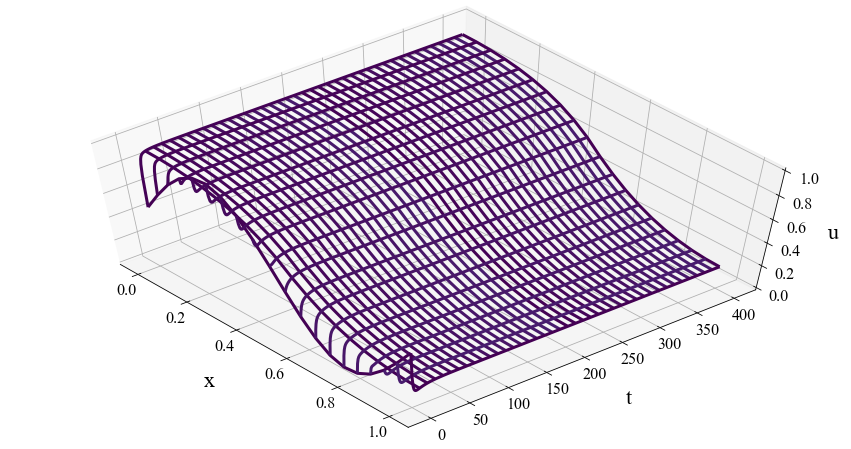
The initial condition \(u_0(\cdot)\) shown in Equation (2.1), as it evolves according to the Allen-Cahn equation (2.2).
One of the first motivations to this project can be found in the interesting paper (Angenent, Mallet-Paret, and Peletier 1987), where they have shown that several nontrivial layered patterns^{Stationary solutions to equation (2.2) that, roughly speaking, gets “concentrated” around values 0 and 1, displaying layers in between these values.} can be found if \(\alpha(\cdot)\) is non-homogeneous in space. There is an extensive discussion about why this is interesting, and we refer the reader to Section 1.1 in the paper.
Remark: You can read more about pattern formation in the book (Nishiura 2002) (Chapter 4.2 deals with the Allen-Cahn model), and also in the very nice article Arnd Scheel wrote to the Princeton Companion to Applied Mathematics, Section IV. 27 (Dennis et al. 2015).
2.1 Propagation with randomly generated coefficients
Next, we would like to evolve and plot the evolution of several different initial conditions in the interval [0,1] (code in Notebook_examples.ipynb). The model that we use is, initially, a discretization of (2.2), with \(\varepsilon = 0\), which then becomes an ODE:
\[\begin{equation} U^{[n+1]} = U^{[n]} + \Delta_t^{u}f(U^{[n]},\alpha^{[n]}),\tag{2.3} \end{equation}\]
where \(f(U^{[n]},\alpha^{[n]}):= U^{[n]}(1 - U^{[n]})(U^{[n]} - \alpha^{[n]} )\).
It is good to have in mind that the coefficients in the above ODE will play the role of trainable weights in Machine Learning: we will “adjust” the coefficients in \(\alpha(\cdot)\) in order to achieve a certain final, target end state.
As mentioned earlier, there is a clear correspondence between the initial value (ODE/PDE) problem and forward propagation and, consequently, the stability of (2.3) has to be considered. The discretization it presents is known as (explicit) Euler method, which is known to be (linearly) unstable in many cases. A good part of the paper was devoted to showing that there is some kind of nonlinear stabilization mechanism that prevents solutions from blowing up, a condition referred to as Invariant Region Enforcing Condition, which establishes a critical threshold for the size of \(\Delta_t^u\), beyond which solutions can blow up. This is discussed at lenght in the paper.
To get this critical value for \(\Delta_t^u\) it is necessary to quantify
\[\begin{equation} \max_{1\leq k \leq \mathrm{N_t}}\max\{1,\vert \alpha^{[k]}\vert\} <+\infty,\tag{2.4} \end{equation}\]
based on which we adjust the parameter \(\Delta_t^u\) accordingly, in a nontrivial way.^{Because, of course, \(\Delta_t^u =0\) also does the job, but does not deliver what we want.} In result, the evolution of \(U^{[\cdot]}\) does not end up in a floating point overflow (in other words, a blow up in \(\ell^{\infty}\) norm).
We set up a little experiment, where in some we obey the Invariant Region Enforcing Condition, and in some we don’t. We take several initial condition on the interval \([0,1]\) and evolving them according to (2.3). Parameters are as follows:
N = 1
init = Initialize_parameters()
prop = Propagate()
dt_vec = np.array([.1,.3,.57,1.5,3,4])
dt, eps, Nx, Nt, dx = .1, 0, N, 20, 1
ptt_cardnlty, weights_k_sharing = Nx, Nt
As discussed in the Appendix A in the paper, the PSBC randomly initializes trainable weights coefficients as realizations of a Normal random variable with average 0.5 and variance 0.1. We set them as uniform random variables in the interval [0,1], which implies that the left hand side of (2.4) is bounded by 1.
param = init.dictionary(N, eps, dt, dx, Nt, ptt_cardnlty, weights_k_sharing)

for i in range(param["Nt"]): param["alpha_x_t"][:,i] = np.random.uniform(0,1)

n_points = 10
V_0 = np.reshape(1/n_points * np.arange(0, n_points + 1), (1, -1))
flow, waterfall, time = prop.forward(V_0, param, waterfall_save = True , Flow_save = True)
We obtain the following figure.
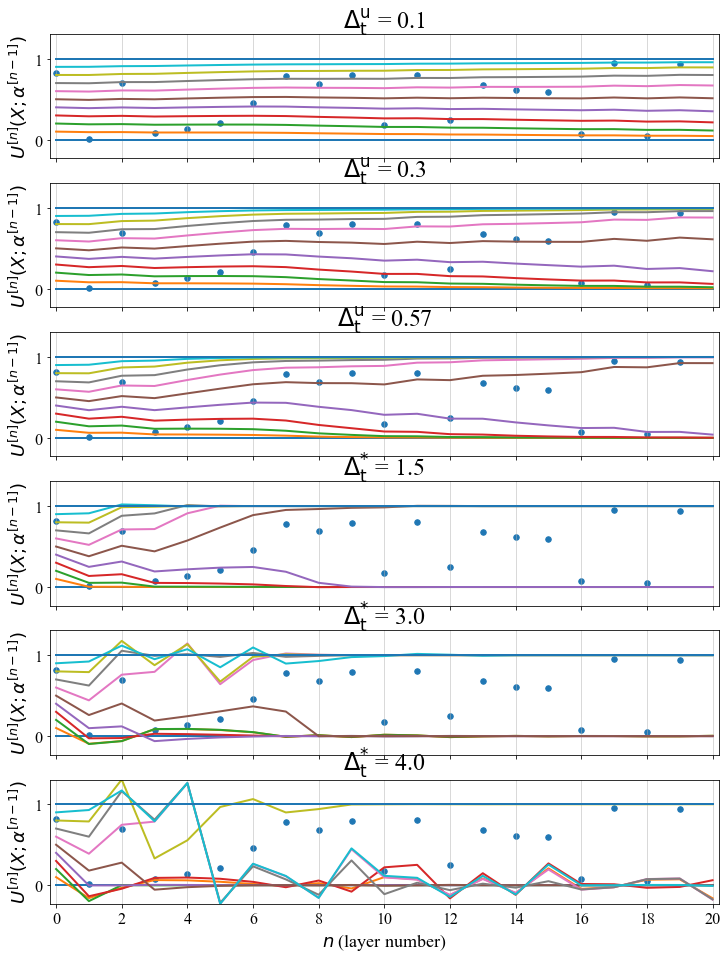
The evolution of initial conditions in the interval \([0,1]\) through the Allen-Cahn-equation (2.2) with \(\varepsilon = 0\) (that is, an ODE) in 1D, with coefficients given by random coefficients generated as an uniform distribution in the interval \([0,1]\).
The reasoning behind the existence of critical values of \(\mathrm{\Delta_{t}^u}\) under which the solution is “well behaved” (that is, the solution is always bounded) goes back to the idea of Invariant regions, exploited extensively in PDEs: we refer the reader to Chapter 14 in (Smoller 1994); if you want to see how it applies in the discrete setting, especially in finite-difference schemes for reaction diffusion models, see (Hoff 1978) and the Appendix C of the paper).
References
Allen, Samuel M, and John W Cahn. 1979. “A Microscopic Theory for Antiphase Boundary Motion and Its Application to Antiphase Domain Coarsening.” Acta Metallurgica 27 (6): 1085–95.
Angenent, S. B., J. Mallet-Paret, and L. A. Peletier. 1987. “Stable Transition Layers in a Semilinear Boundary Value Problem.” J. Differential Equations 67 (2): 212–42. https://doi.org/10.1016/0022-0396(87)90147-1.
Aronson, D. G., and H. F. Weinberger. 1978. “Multidimensional Nonlinear Diffusion Arising in Population Genetics.” Adv. In Math. 30 (1): 33–76. https://doi.org/10.1016/0001-8708(78)90130-5.
Dennis, Mark R., Paul Glendinning, Paul A. Martin, Fadil Santosa, and Jared Tanner, eds. 2015. The Princeton Companion to Applied Mathematics. Princeton University Press, Princeton, NJ. https://doi.org/10.1515/9781400874477.
Fife, Paul C. 1979. Mathematical Aspects of Reacting and Diffusing Systems. Vol. 28. Lecture Notes in Biomathematics. Springer-Verlag, Berlin-New York.
Hoff, David. 1978. “Stability and Convergence of Finite Difference Methods for Systems of Nonlinear Reaction-Diffusion Equations.” SIAM J. Numer. Anal. 15 (6): 1161–77. https://doi.org/10.1137/0715077.
Nishiura, Yasumasa. 2002. Far-from-Equilibrium Dynamics. Vol. 209. Translations of Mathematical Monographs. American Mathematical Society, Providence, RI.
Smoller, Joel. 1994. Shock Waves and Reaction-Diffusion Equations. Second. Vol. 258. Grundlehren Der Mathematischen Wissenschaften [Fundamental Principles of Mathematical Sciences]. Springer-Verlag, New York. https://doi.org/10.1007/978-1-4612-0873-0.